


What Is A Dog Head Halter?
Estimated read time: 12 minutes
Table of Contents
- What is a dog head halter?
- What are the benefits of a dog head halter?
- Why does my dog pull on leash?
- A loose leash is essential when walking your dog
- Do dog head halters work?
- Are head halters safe for dogs?
- Are head halters cruel?
- Your dog’s comfort should come first
- How does a dog head halter work?
- How do you fit a dog head halter?
- How tight should a head halter be?
- Can a puppy wear a head halter?
- Your adult dog and head halters
- Conditioning your dog to wearing a head halter
- What is the best head halter for my dog?
- The Canny Collar
- How does the Canny Collar work?
- Why is the Canny Collar different to other head halters like the Halti or Gentle Leader?
- A kind dog head halter
- A million dog owners can’t be wrong
- A head halter is not a substitute for dog training
- Be a responsible dog owner
- Is a dog head halter to be used forever?
- Conclusion
Dog head halters: Train your dog not to pull on leash
Pulling on leash is the most common problem faced by dog owners. If you have ever experienced this when walking your dog, you’ll know how stressful, frustrating and embarrassing it can be.
Not to mention the potential for injury if you are pulled off your feet.
In this post, we’re going to explain what a dog head halter is and help you decide if it is the right training aid for you and your dog.
Why us? We have helped over a million owners around the world like you to enjoy walking their dog on a loose leash. No pulling, frustration or stress.
Happy dogs and happy owners. Let's get started.

What is a dog head halter?
A head halter is a tool designed to help train your dog to stop pulling on leash and walk politely to heel. It is sometimes called a head collar, a halti collar, an anti pull collar or a dog nose leash.
There are several brands of dog head halter on the market. The best one for you and your dog will be one which is comfortable, simple to fit, easy to use and effective.
"The best head halter for your dog is comfortable, kind, safe and effective"
What are the benefits of a dog head halter?
The most obvious benefit is that a head halter can help to train your dog to walk on a loose leash without pulling. Like any tool, it makes a job easier.
Head halters also often have a calming effect on some dogs. There is less excitement and/or distraction when training so that your dog is more focused on you.
Although their main purpose is for training, head halters can also be beneficial for dogs that jump or lunge at other dogs, passers-by or traffic. You can gain control over your dog more easily if you are able to control her head.
A head halter can stop your dog from picking up waste food and other undesirable items from the floor.

Why does my dog pull on leash?
Dogs respond to a tight leash with an ‘oppositional reflex’, or thigmotaxis. This means that they pull back in the opposite direction to any pressure they feel on the leash.
This results in a perpetual tug-of-war with the stress, embarrassment and potential for injury to you both. As owners, we think that by pulling tightly on the leash that we are in control of our dog but clearly we're not.
To stop the pulling, we have to teach our dog what we want them to do when they feel this leash pressure.
"You will never walk a dog well on a tight leash"
A loose leash is essential when walking your dog
If our leash never loosens, we are simply restraining our dog from moving forwards instead of training them not to pull. This is where a head halter can help.
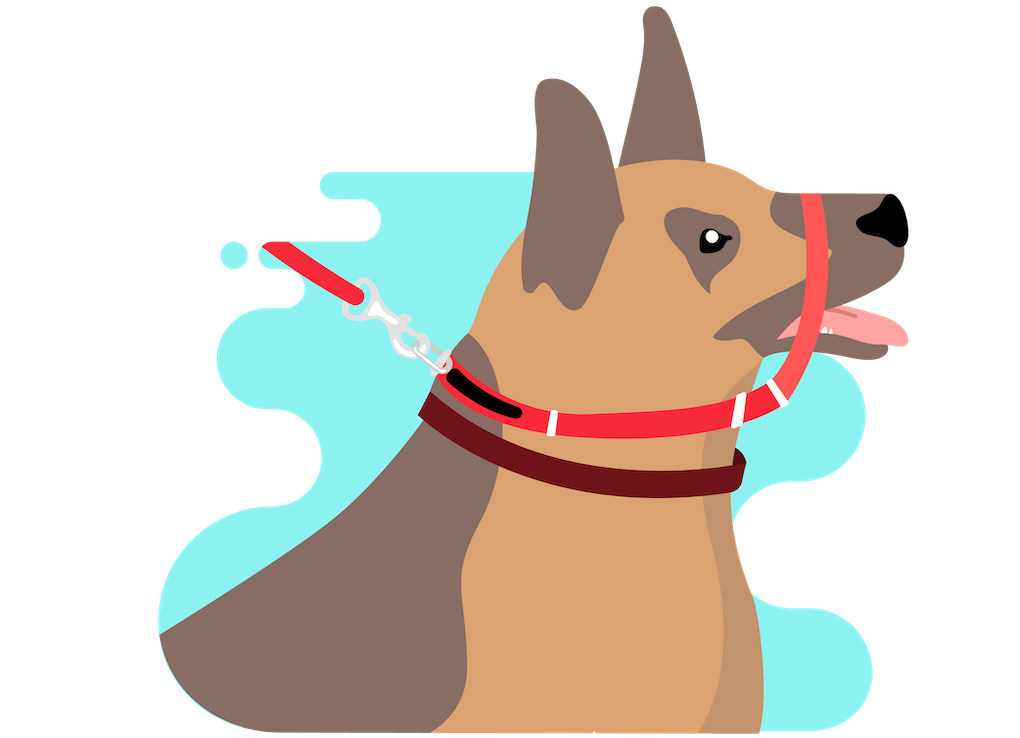
A good head halter will loosen around your dog’s face when the pressure on the leash is released. This is how your dog learns to stop pulling.
When you apply gentle backwards pressure with your leash, your dog has to stop moving forwards. By immediately releasing the pressure, your dog experiences the leash going slack.
Your momentum then allows you to catch her up and offer vocal praise. She learns the position you would like her to be in when on your walk.
"Training, not restraining, is the name of the game"
Do dog head halters work?
For most dogs, yes. A head halter helps dogs to learn good walking habits. This works for young pups and older dogs whose training to date may have been been limited.
For persistent pullers and rescue dogs whose history is unknown, it can be an invaluable tool. It is sometimes the difference between whether a rescue dog is returned to a shelter or not.
"A head halter is an effective training aid which can speed up the time it takes to train your dog to walk politely"
Are head halters safe for dogs?
Absolutely. It’s important to follow the fitting instructions and check that the halter cannot come over your dog’s head before you begin your walk. The fit around your dog's neck should be more snug than her normal collar.
If you are concerned that your dog may slip out of the head halter, a good idea is to use a double-ended training leash. Clip one end to the head halter and another to your dog’s regular collar for backup.
Never walk with too long a leash when using your head halter. If your dog moves quickly and reaches the end of a long leash, there is potential for injury to the neck or spine.
A leash of around 4 feet is ideal. This allows for close control without the leash being too long.
Are head halters cruel?
Not at all. They are used by many respected organizations such as the ASPCA, Irish Guide Dogs & Dogs Trust. Many dog trainers, dog training schools, veterinarians and rescue shelters recommend them as part of their training programs.
Ultimately, they are only as good as the person on the other end of the leash and the time they put in to training their dog. When walking, only a gentle ‘pressure and release’ action should be required if your dog pulls.
"If a head halter is pulled hard or yanked, there is a risk of injury to your dog"
Head halters that fasten under the chin tend to close your dog’s mouth when pressure is applied to the leash but there is no real benefit in clamping your dog’s mouth shut if all we are doing is teaching her to walk politely to heel.
Others allow your dog to keep her mouth open so that she can breathe and pant during training.
Your dog’s comfort should come first
The most important consideration when choosing a dog head halter is that it should be comfortable for your dog. It should be safe for you both and effective in helping you learn together.
Some halters have several straps around your dog’s face while others may only have a single noseband. Choose the one you think will be most comfortable for the type of snout your dog has.
A padded noseband is a feature of some brands but is not always necessary if the fabric over the nose is soft, strong and comfy.

How does a dog head halter work?
- Most head halters work on the principle that if you can control your dog’s head, then the body will follow. A bridle on a horse works in the same way.
- Pressure is applied to the nose and released when your dog stops pulling. Praising your dog for walking well positively reinforces the good behavior we desire, which is to walk beside us with the leash loose.
- This ‘pressure and release’ action harnesses your dog’s own energy to learn good walking habits.
- It’s important to combine this 'negative reinforcement' with positive reinforcement training. A head halter alone is not a substitute for good training.

How do you fit a head halter?
Each brand of head halter has its own unique fitting instructions. It's important that you follow these closely for the comfort and safety of your dog.
Despite this, some people will not read the instructions. This is a mistake. Your dog’s success or otherwise depends on you knowing how to use this training tool properly.
"Not all head halters have the same design, nor do they work in the same way"
On most brands, the leash attaches underneath the chin. Others use a behind-the-head fastening. Your dog feels a clear difference between ‘on’ and ‘off’ with this design as there is no continuous downward pressure from the weight of the leash or clip.
An extra benefit of this design is that your dog cannot get their paw onto the leash and pull the halter over their head.
How tight should a head halter be?
A head halter should fit snugly so that it cannot come off and potentially put your dog in danger. If you are attaching your regular leash to the halter only, this is doubly important.
If in doubt, use a double-ended training leash. Attach one clip to the head halter and the other to your dog’s regular collar.
Can a puppy wear a head halter?
Starting your puppy training with a head halter is a great way to get off on the right foot. We wouldn't expect a baby or toddler to adapt to a new experience immediately and it is the same with our dogs. Start slowly and patiently.
Do you remember how strange it was the first time you wore a watch? Or a cycling helmet? For puppies, wearing a head halter can be a similar experience and it may feel a little strange at first.

Susan Garrett, the respected Canadian dog trainer, recommends starting early and taking several weeks to condition your puppy to a head halter before using it on a walk.
A progressive approach will set your dog up with good training habits for life. We recommend that you wait until your puppy is happy to wear her regular collar and understands the idea of walking on leash. For most dogs, this will be at around 4-6 months old.
"A head halter can instil good walking habits for life"
Your adult dog and head halters
Most adult dogs will accept a head halter instantly and others will take a couple of weeks to get used to wearing it.
Very few dogs will never accept wearing a head halter. This is usually due to the owner using it incorrectly or not persevering if the dog didn’t like wearing it at first.
At first, some dogs may dislike the feel of having a head halter on their nose. For these dogs, it’s important to gradually condition them to wearing it.
Conditioning your dog to wearing a head halter
Most dogs will happily accept wearing a head halter right away. If your dog does not accept it immediately, you may need to condition him to wearing it using the following steps:
- Establish a positive association with the halter, such as using your dog’s favourite treats when you bring it out. Let her sniff it.
- Once your dog is happy to see it, the next step is fitting the collar part around the neck and putting the nose band over the nose. Hold a treat in one hand and put the nose band over this hand so that you can place it over your dog’s nose and pop a treat into her mouth at the same time. Wait for a few seconds, then slip it off and ignore your dog.
- Repeat this step a few times. If your dog paws the nose band off, simply stop the treats/attention/vocal praise and ignore. Wait a short time and start again.
- Once your dog accepts wearing the head halter, let her wear it around the house for short periods with the leash attached.
- Now you’re ready to go into the garden or outside the house in an area with few distractions. Do short bursts of training of up to five minutes. Be sure to reward your dog with vocal praise/treats when she is walking well on a loose leash.

What is the best head halter for my dog?
When choosing a collar to stop your dog pulling on leash, every brand will claim to be ‘the best’. But there is no 'one fits all' solution.
The best head halter for you and your dog will be the one which is the most comfortable. It should be simple to fit, easy to use, kind, safe and effective.
Your choice will depend on your dog’s size, breed & temperament plus how much training you wish to do. Do you want to use your halter permanently? Or would you like to eventually train your dog to walk on a regular collar and leash?
Some brands encourage permanent use. Others are designed so that you can slip the noseband on and off during training. These collars are best if you want to gradually wean your dog off using them.
Some breeds like Pugs and French Bulldogs have virtually no nose and a head collar will simply will not work for them. Others, like Boxers, have a short, wide snout which makes some brands of head halter unsuitable.
"Choose the right head halter for you and your dog"
The Canny Collar
The Canny Collar is a simple dog head halter with a single, self-adjusting and removable noseband.
The innovative 'behind-the-head' design makes it easy to fit and simple to use. This means that it will also not ride up into your dog’s eyes nor yank her head to one side.
"The Canny Collar was voted 'Best New Product' by the UK Pet Product Retail Association shortly after it was launched and is now used by trainers, veterinarians and rescue shelters worldwide"

How does the Canny Collar work?
The Canny Collar works using the recommended 'pressure and release' system. If your dog pulls on the leash, she will feel pressure on the bridge of her nose. When she doesn't pull, there is no pressure.
Once the pressure is immediately released, the leash slackens when your dog is walking at your side. With your arm relaxed, the Canny Collar automatically does the corrective work. You are free to praise or reward your dog for walking calmly by your side.
Your dog soon learns that by not pulling ahead, the walk is more comfortable for you both. You can positively reinforce the experience with vocal praise and/or her favourite treat.
Why is the Canny Collar different to other head halters like the Halti or Gentle Leader?
Apart from its unique design, the Canny Collar functions differently:
- The Canny Collar fastens behind the head rather than under the chin. The immediate benefit is that there is no yanking your dog's head to one side nor riding up into her eyes.
- Collars that fasten underneath the chin can stop your dog pulling but do little to teach her not to pull. Your dog will often start pulling again when not wearing it. A Canny Collar is not for controlling your dog but for teaching her.
- A Canny Collar allows your dog more control over their own training. Your dog learns herself through self-regulation: when they pull, there is tension, when they don’t the tension is released. Without the owner pulling their head to one side, dogs are able to work it out for themselves. This is a good example of operant conditioning, allowing your dog to choose to walk on a loose leash themselves rather than being forced to do so by their owner.
- The Canny Collar uses a single piece of material over your dog’s face which attaches to the leash at the back of the head. It expands to fit the wider snout of a Boxer or contracts for the slimmer snout of a Greyhound. This gives a perfect fit without affecting the functionality.
- The Canny Collar can be quickly and easily switched into a regular dog collar. Simply flick the noseband on and off your dog's nose when needed. By doing this you can eventually train your dog to walk on a conventional flat collar.
- The Canny Collar doesn’t have to be removed when your dog is off leash and can be safely left on while your dog runs free.
- As the leash attaches behind your dog’s head, she cannot get her paw over it and remove the Canny Collar.
A kind dog head halter
The collar itself is generously padded for comfort and the single noseband is soft and comfy. This allows your dog to breathe freely, open her mouth and enjoy her walk.
"The lightest of touches is needed when your dog pulls"
When the leash is loose, your dog feels no pressure at all on her face as she walks calmly by your side.

A million dog owners can’t be wrong
If you're looking to stop your dog pulling on leash, you’ll be in good company. More than a million dog owners worldwide have now discovered the simple pleasure of walking their dogs on a loose leash.
If you have a giant breed, the Canny Colossus is the larger version of the Canny Collar and is a head halter especially made for large dogs.
But don't take our word for it, read some Canny Collar reviews here. Join these happy owners today and make walking your own dog easy and enjoyable.
A head halter is not a substitute for dog training
Whilst head halters can help with training your dog, they are not a substitute. This is something that all responsible dog owners should do to ensure that your dog becomes a responsible canine citizen and is welcomed by other dogs and owners.
Dog trainer Susan Garrett is very clear that a head halter is not a ‘set it and forget it’ device. You cannot just fit it and then absent-mindedly walk your dog down the road.
Susan has used a head halter on every dog she has ever trained since the 1990s. She does this because it commits her to a training session every time she walks her dog.
Be a responsible dog owner
Putting your dog on a leash is like driving a car – you don’t just switch off. Your responsibilities are to be aware of what is happening in the moment and to know what is going on around you.
When walking your dog, look for potential hazards up ahead so that you are prepared for what may distract your dog. The aim when training on a head halter is to move our dog’s focus from everyday distractions back to you.
"A head halter is not a device that can help with more serious behavioral issues encountered when walking your dog"
If your dog is unsociable or aggressive to other dogs or people, look for a qualified dog trainer or behavioral therapist.
Is a head halter to be used forever?
By training your dog to walk effectively on a good head halter you should be able to transition to walking on a regular collar without pulling. The Canny Collar is designed for this purpose.
If the head halter is loose around your dog’s face and you prefer to simply leave it on then it is fine to continue like this. The aim is to make walks for both of you easier and more enjoyable.

Conclusion
You may or may not need a head halter to help you train your dog to walk well. But it can speed up the learning process.
If you decide to purchase one, the best halter for you and your dog will be comfortable, kind, safe and effective. It should be simple to fit and easy to use.
A head halter is not a substitute for training which is something every responsible dog owner should do.


5 comments
We have just started using a canny collar with our 5 month old golden retriever. Walks are much improved just after a few days. However, getting the collar on her is a real wrestling match. Any helpful tips appreciated. Also, after a walk we can see the indentation on her snout. Is that a concern?
We have just started using a canny collar with our 5 month old golden retriever. Walks are much improved just after a few days. However, getting the collar on her is a real wrestling match. Any helpful tips appreciated. Also, after a walk we can see the indentation on her snout. Is that a concern?
I’m getting older and she still is not dog friendly. She is human happy if i introduce the person. She is friends with several dogs that i allowed her to get to know. She pulled so hard a month ago that she sprained my pinkie. I was given this collar and am hopeing this will work. I will let you know.